Showing posts with label cybersecurity. Show all posts

Sunday, January 28, 2024

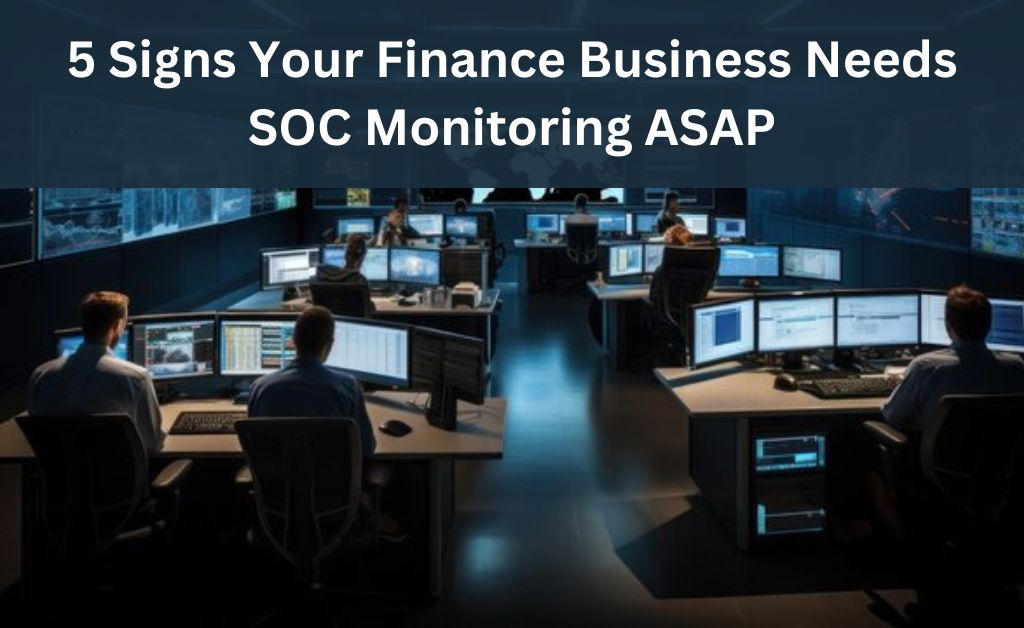
5 Signs Your Finance Business Needs SOC Monitoring ASAP


In the rapidly evolving landscape of the finance industry, data security is of paramount importance. As financial institutions increasingly rely on technology to streamline operations and manage sensitive information, the risk of cyber threats looms larger than ever. To safeguard your finance business against potential breaches, it's crucial to invest in a Security Operations Center (SOC) service. Here are five signs that indicate your finance business needs SOC monitoring ASAP.

1. Escalating Cyber Threats in the Finance Sector
The finance sector is a prime target for cybercriminals due to the valuable data it holds. From customer financial records to transaction details, the information at stake is incredibly sensitive. If you've noticed an uptick in cyber threats targeting financial institutions, it's a clear signal that your business needs to bolster its cybersecurity measures. SOC monitoring provides real-time threat detection and response, helping to mitigate risks before they escalate.

2. Increasing Regulatory Compliance Pressures
Governments and regulatory bodies are tightening the reins on data protection, especially in the financial industry. Compliance with regulations such as GDPR, HIPAA, or industry-specific mandates is non-negotiable. A SOC service ensures that your finance business adheres to these regulations by actively monitoring and responding to potential security incidents. Avoiding compliance issues not only protects your reputation but also shields your business from hefty fines.

3. Unusual Network Activities and Anomalies
Unexplained network activities and anomalies can be early indicators of a cyber attack. If your finance business experiences unexpected patterns in network traffic, unauthorized access attempts, or unusual login behavior, it's time to take proactive measures. SOC monitoring uses advanced analytics to identify and investigate these anomalies, helping your business stay one step ahead of potential threats.

4. Lack of In-House Cybersecurity Expertise
Maintaining an in-house cybersecurity team with the expertise to combat evolving threats can be challenging and expensive. Many finance businesses, especially smaller ones, may find it more practical to leverage SOC services. By outsourcing your cybersecurity to a specialized team, you gain access to a pool of experts dedicated to monitoring, analyzing, and responding to security incidents around the clock.

5. Previous Security Incidents or Breaches
If your finance business has experienced security incidents or breaches in the past, it's a red flag that your current cybersecurity measures may not be sufficient. A SOC service learns from previous incidents, adapting its monitoring strategies to fortify your defenses against similar threats in the future. Investing in proactive monitoring is a crucial step in preventing recurring security lapses.

Conclusion: Protect Your Finance Business with SOC Monitoring
In an era where cyber threats are omnipresent, the importance of robust cybersecurity measures cannot be overstated. A SOC service acts as a dedicated guardian for your finance business, providing continuous monitoring, threat detection, and rapid response capabilities. Don't wait until a cyber attack compromises your sensitive data – invest in SOC monitoring ASAP to secure the future of your finance business.

Thanks and Regards,

Saturday, December 2, 2023

The 3 Pillars of Cybersecurity: How SOC Monitoring Delivers Early Threat Detection


Explore the fundamental pillars of cybersecurity and discover how SOC Monitoring Services, backed by SOC as a Service providers, provide crucial early threat detection.


Introduction:

In the ever-evolving landscape of cybersecurity, a robust defense relies on three fundamental pillars: prevention, detection, and response. This blog explores the significance of SOC Monitoring Services in delivering early threat detection, with a focus on the expertise offered by SOC as a Service providers.


1. Prevention:

Preventing cyber threats is the first line of defense. While traditional security measures lay the groundwork, SOC Monitoring Services add an extra layer of proactive defense. By constantly monitoring network activities and configurations, potential vulnerabilities can be identified and addressed before they are exploited.


2. Detection:

Early threat detection is a game-changer in cybersecurity. SOC Monitoring Services leverage advanced technologies and threat intelligence to identify anomalous activities and potential security breaches. This proactive stance enables organizations to detect threats in their infancy, minimizing the impact of cyberattacks.


3. Response:

Effective response is the final pillar of a comprehensive cybersecurity strategy. SOC Monitoring Services, often facilitated by SOC as a Service providers, streamline incident response. Rapid identification of threats allows for quick and efficient mitigation, ensuring minimal damage and downtime.


SOC as a Service Providers:

SOC as a Service companies play a crucial role in enhancing the capabilities of SOC Monitoring Services. Their expertise, scalable solutions, and 24/7 vigilance empower organizations to fortify their cybersecurity defenses without the need for extensive in-house resources.


Conclusion:

The three pillars of cybersecurity—prevention, detection, and response—are fortified by the proactive capabilities of SOC Monitoring Services. Leveraging the expertise of SOC as a Service providers, organizations can achieve early threat detection and ensure a resilient defense against evolving cyber threats.


Thanks and Regards,

Priya - IARM Information Security

SOC as a Service Provider ||  SOC Service Vendor || SOC Monitoring Service


Wednesday, November 15, 2023

SIEM Strategies for Online Merchants: Strengthening Cyber Defences:


In the fast-paced realm of e-commerce, the need for robust cybersecurity measures has never been more critical. With cyber threats evolving in sophistication, the implementation of a Security Information and Event Management (SIEM) system becomes paramount for online retailers. This blog will guide you through the essential steps to ensure a successful SIEM deployment tailored to the unique challenges of e-commerce.


Step 1: Assess E-Commerce Specific Risks

Before delving into SIEM implementation, it's crucial to identify the specific cybersecurity risks faced by online retailers. This includes understanding potential points of vulnerability in the e-commerce platform, such as customer data, payment gateways, and third-party integrations.


Step 2: Define Security Objectives

Clearly outline the security objectives for your e-commerce business. Whether it's safeguarding customer information, ensuring transaction integrity, or meeting regulatory compliance, a well-defined set of objectives will guide your SIEM deployment strategy.


Step 3: Select the Right SIEM Solution

Evaluating and choosing the right SIEM solution is pivotal. Options range from in-house solutions to SIEM as a service, allowing e-commerce businesses to tailor their cybersecurity approach based on their size, resources, and specific security requirements. Open source SIEM solutions also provide cost-effective alternatives with customization capabilities.


Step 4: Integration with E-Commerce Infrastructure

Seamless integration with the e-commerce infrastructure is critical for SIEM effectiveness. This involves configuring the system to monitor online transactions, track user activities, and detect anomalies in real-time. The goal is to fortify the e-commerce platform against potential cyber threats.


Step 5: Incident Response Planning

Develop a comprehensive incident response plan tailored to the e-commerce environment. This includes protocols for addressing potential breaches, minimising downtime, and safeguarding customer trust. Quick and effective response procedures are essential in the dynamic world of online retail.


Step 6: Training and Awareness

Educate your e-commerce team on the SIEM system's functionalities and the unique cybersecurity challenges faced by online retailers. Building awareness ensures that your team can interpret alerts accurately and respond effectively to potential threats.


Step 7: Continuous Monitoring and Adaptation

Implement continuous monitoring to stay ahead of evolving cyber threats. Regularly update and adapt your SIEM configurations based on emerging risks and the changing landscape of e-commerce. This proactive approach is crucial for maintaining a secure online retail environment.


In conclusion, implementing SIEM for e-commerce is a proactive strategy in the face of ever-evolving cyber threats. Whether opting for SIEM as a service, exploring open source solutions, or deploying an in-house system, following a structured roadmap is key to fortifying your online retail business against the complex landscape of cyber threats.


Friday, February 24, 2023

Is Your Connected Vehicle Safe from Cyber Attacks? Explore the Role of Cloud Security


Connected vehicles and smart transportation systems have been rapidly increasing in popularity due to their benefits in improving the efficiency, safety, and convenience of transportation. These systems rely on sensors, artificial intelligence, and cloud computing to process and analyse data that is collected from various devices, including traffic signals and other smart devices. 


However, with the increased use of these systems comes an increased risk of cyber attacks, which could lead to disastrous consequences. In this blog post, we will explore the role of cloud security services in securing connected vehicles and smart transportation systems.


The Risks of Cyber Attacks on Connected Vehicles


Cybersecurity threats to connected vehicles include potential scenarios where vehicles can be hacked by malicious actors. For instance, hackers could take control of a vehicle's brakes, steering, or acceleration. 


This could lead to accidents, injuries, and fatalities. Additionally, cybercriminals could steal sensitive data and personal information, such as geolocation data, driving habits, and credit card details. This could result in identity theft, financial fraud, and other malicious activities.


Cloud Security in Connected Vehicles


To ensure the security of connected vehicles, cloud security services and solutions play a vital role. Cloud computing provides a scalable and flexible infrastructure that can manage large amounts of data and improve the performance of connected vehicles. However, to ensure the protection of sensitive data, cloud security measures must be implemented. 


Encryption, access controls, and firewalls are just a few examples of the security measures that can be used to safeguard against cyber attacks. Additionally, cloud providers should conduct regular security audits and maintain up-to-date security standards to ensure that their cloud services remain secure.


Ensuring Security in Smart Transportation Systems


Securing connected vehicles is not enough to ensure the safety of smart transportation systems. The infrastructure that supports these systems, such as traffic signals, road sensors, and other smart devices, must also be secured. 


One way to achieve this is by using cloud security to protect these systems. By implementing security measures such as access controls, encryption, and firewalls, smart transportation systems can be better protected against cyber attacks.


The Future of Cloud Security in Connected Vehicles


As connected vehicles and smart transportation systems continue to grow, the future of cloud security will need to adapt to these changes. One such change is the emergence of autonomous vehicles, which rely heavily on cloud computing. 


Cloud security measures will need to be developed and implemented to ensure the safety of these vehicles. Additionally, as smart cities continue to be developed, the infrastructure that supports these systems will need to be secured with cloud security measures.


Connected vehicles and smart transportation systems have become a reality in recent years, providing benefits in efficiency, safety, and convenience. However, these systems come with an increased risk of cyber attacks that could result in disastrous consequences. 


Cloud security services play a vital role in securing these systems by protecting sensitive data and personal information, implementing security measures, and securing the infrastructure that supports these systems. As connected vehicles and smart transportation systems continue to evolve, the future of cloud security will need to adapt to ensure their safety.


Thanks and Regards,

Andrea - IARM Information Security

Vulnerability Assessment services || Cloud security services|| VAPT Service provider in India


Monday, February 20, 2023

How Manufacturing Industries can Use SIEM Effectively

A Survival Guide from Professionals

Manufacturing organisations are among the many industries that face a growing threat of cyber attacks. With the increasing use of interconnected machines, automation systems, and Internet of Things (IoT) devices, the attack surface for manufacturing networks is expanding rapidly. 

That's why it's more important than ever for manufacturers to have a robust cybersecurity system in place to protect their assets and maintain operational efficiency. One solution that can help is a Security Information and Event Management (SIEM) service.

What is SIEM?
A SIEM service provides a  security tool that collects and analyses data from various sources within an organisation's network to identify potential threats and vulnerabilities. It combines security information management (SIM) and security event management (SEM) capabilities to provide a comprehensive view of an organisation's security posture.

How SIEM Works

A SIEM system typically consists of three main components:

  • Data collection: The SIEM collects data from a variety of sources, including network devices, servers, applications, and security systems. This data is often ingested in real-time, but some SIEMs also allow for batch data collection

  • Data analysis: The collected data is analysed by the SIEM using rules, algorithms, and machine learning techniques to identify potential threats or anomalies.

  • Alerting and response: If the SIEM detects a potential threat or anomaly, it can generate an alert and provide information about the threat to security staff. These alerts can be delivered in real-time through various methods, such as email, SMS, or a security operations centre (SOC) console. Security staff can then use this information to investigate and respond to the threat.

Also Read, How to Choose Right SIEM Solution for my Organisation


How SIEM Service Can Benefit Manufacturing

There are several ways that a SIEM service can benefit manufacturing organisations:

  • Real-time threat detection and response: By continuously monitoring an organisation's network and alerting security staff to potential threats in real-time, a SIEM can help manufacturers respond quickly to minimise the impact of a potential breach.

  • Improved operational efficiency: A SIEM can help manufacturers streamline their operations by providing insights into their network and identifying areas of inefficiency. For example, a SIEM can detect bottlenecks in the manufacturing process, which can help manufacturers optimise their workflow and reduce downtime.

  • Compliance assistance: Manufacturers are subject to strict regulatory requirements when it comes to data protection and cybersecurity. A SIEM can help these organisations meet these requirements by tracking and monitoring relevant security events and providing reports as needed.

  • Enhanced visibility: A SIEM provides a single, centralised view of an organisation's security posture, making it easier for security staff to identify and address potential threats. This improved visibility can help manufacturers proactively protect against cyber attacks.

  • Customised threat detection: A SIEM can be configured to detect specific types of threats or anomalies that are relevant to manufacturing organisations. This customization allows the SIEM to more effectively identify potential threats and provide alerts to security staff.

Manufacturing organisations face unique challenges when it comes to cybersecurity and operational efficiency. A SIEM service can help manufacturers improve their cybersecurity posture and streamline their operations by providing real-time threat detection and response, improved operational efficiency, compliance assistance, enhanced visibility, and customised threat detection. By implementing a SIEM, manufacturing organisations can protect their assets and maintain business continuity in the face of a growing threat of cyber attacks.


Saturday, February 11, 2023

How Vulnerability Assessments and Penetration Testing Keep Pharmaceuticals Safe

 Defending Against Threats


The pharmaceutical industry is responsible for developing, manufacturing, and distributing life-saving and life-enhancing drugs and medical products. As such, the security of the pharmaceutical supply chain is of the utmost importance. Vulnerability assessments and penetration testing are essential tools for identifying and addressing vulnerabilities in the pharmaceutical industry, ensuring that products are safe and secure. Opting the right VAPT service provider  also plays a vital role in security.


The Importance of Vulnerability Assessments and Penetration Testing in Pharmaceuticals


Vulnerability assessments and penetration testing help to identify potential security threats and risks, including those that may result from physical attacks, cyber attacks, and natural disasters. By identifying and addressing these vulnerabilities, the pharmaceutical supply chain can be made safer and more secure, reducing the risk of harm to patients and the public.


The Process of Conducting Vulnerability Assessments and Penetration Testing


Vulnerability assessment services in the pharmaceutical industry typically involve a thorough examination of the supply chain, including the processes and technologies used to manufacture, distribute, and dispense drugs and medical products. This may include a review of physical security measures, such as access controls, as well as a review of the system's cybersecurity measures, such as firewalls and encryption.


Penetration testing services usually involve simulating a real-world attack on the system to identify vulnerabilities and evaluate the effectiveness of security measures. This testing can help to identify potential weaknesses in the supply chain and inform improvements to the security of the system.


Benefits of Conducting Vulnerability Assessments and Penetration Testing in Pharmaceuticals


Conducting vulnerability assessments and penetration testing in the pharmaceutical industry offers a number of benefits, including:


  • Improved safety: By identifying and addressing potential security risks, the pharmaceutical supply chain can be made safer for patients and the public.


  • Enhanced security: Conducting vulnerability assessments and penetration testing can help to identify and prevent potential security breaches, reducing the risk of data theft or malicious attacks.


  • Increased efficiency: By addressing vulnerabilities, the pharmaceutical supply chain can operate more efficiently, reducing the risk of downtime and disruption.


  • Better preparedness: By identifying potential threats, the pharmaceutical industry can be better prepared to respond to emergencies, reducing the risk of harm to patients and the public.


Vulnerability assessments and penetration testing are essential tools for ensuring the safety and security of the pharmaceutical supply chain. By identifying and addressing potential vulnerabilities, the industry can operate more effectively and securely, reducing the risk of harm to patients and the public. Whether you are involved in the pharmaceutical industry or simply rely on its products to stay healthy, it is important to understand the importance of vulnerability assessments and penetration testing and to take steps to ensure the safety and security of the pharmaceutical supply chain.


Thanks and Regards,

Andrea - IARM Information Security

VAPT Service Provider || Vulnerability assessment Service || Penetration Testing Service Provider in India


Monday, December 19, 2022

5 Major Cyber Threats to Food and Agriculture Sector

The food industry has become a popular target for hackers. The reason is that the food industry is a centralized system, with many points of vulnerability. Hackers are targeting these vulnerabilities with the goal of disrupting food supply chains and causing economic damage to the industry.

In order to protect themselves from cyber-attacks, food companies need to take several measures. It is important to be aware that threat actors, including hackers and cybercriminals, may target businesses in the food and agriculture industry. Protect your digital supply chain with cybersecurity hygiene.


A major cyber threat to the food and agriculture sector is the possibility of data extraction. Threat actors may use a variety of tactics to target businesses in the food and agriculture industry, including:

  1. Phishing attacks: These are fraudulent emails or messages that attempt to trick the recipient into divulging sensitive information, such as login credentials, or into clicking on a link that downloads malware.
  2. Malware: This is malicious software that can infect a computer or network and allow the attacker to gain access to or control over the system.
  3. Denial of service (DoS) attacks: These attacks aim to overwhelm a website or network with traffic, making it unavailable to legitimate users.
  4. Ransomware attacks: These attacks involve the attacker encrypting a victim's data and demanding payment in exchange for the decryption key.
  5. Business email compromise (BEC) is a type of cybercrime that involves the attacker gaining access to or control over a victim's email account and using it to send fraudulent messages to the victim's business partners or customers. In the context of the food and agriculture industry, BEC attacks can be used to steal large shipments of food products or ingredients
Food and agricultural businesses are at risk from cybercrime. But you can protect your organization with the right security measures. Join IARM as we explore the best ways to protect your business against these hazards

Here is an example of how a BEC attack might occur:

  • The attacker gains access to the email account of an employee at a food or agriculture business, such as a purchasing manager or supply chain coordinator.
  • The attacker begins monitoring the employee's emails to learn about the business's operations, supplier relationships, and upcoming shipments.
  • The attacker crafts a fraudulent email that appears to be from the employee and sends it to the business's supplier, requesting a large shipment of food products or ingredients to be delivered to a different location than the one that was previously agreed upon.
  • The supplier, believing the request to be legitimate, arranges for the shipment to be delivered to the new location.
  • The attacker intercepts the shipment and sells the food products or ingredients on the black market.

To protect against BEC attacks, it is important for businesses in the food and agriculture industry to implement robust cybersecurity measures, such as using multi-factor authentication and training employees to be aware of the signs of a BEC attack. It is also important for businesses to verify the authenticity of any requests for changes to shipping addresses or other important details before acting on them. 

IARM, Cyber security company that specializes in the food and agriculture industry. We identify, understand and provide solutions to the risks you face everyday.  Our cybersecurity experts will assess your business and environment to identify vulnerabilities and provide a long-term solution for your IT needs and  protect businesses from the threats of malicious cyberattacks.

 Thanks and Regards,


Monday, June 21, 2021

Security Alert : Ethical disclosures are being ignored, resulting in an uncontrollable security issue


Ethical disclosures are being ignored, resulting in an uncontrollable security issue


The secret phrase being referred to, "solarwinds123," was ludicrously simple. The high-stakes show that it might have set off, with Russian programmers keeping an eye on government offices and organisations, was absolutely true to life. 

However, the news that spilled out of IT the executives organisation Solar Winds recently, with agitators from Russia controlling the organisation's security shortcomings to cause perhaps the most exceedingly awful security penetrate in U.S. history, is neither engaging nor entertaining. It's dangerous genuine, and it's anything but a tune of pundits posing a similar reverberating inquiry: what did Solarwinds think about their weaknesses, and for what reason didn't somebody act prior? 

The moral issues that exist around the wake of found security weaknesses are tremendous and cloudy. What's more, now and again, everything seems recognizable and excessively simple. Like poker players, a significant number of these environments have a "tell" that a talented player can undoubtedly recognize. 

These disclosures come as little amazement. Yet, what is regularly stunning is the response — or deficiency in that department — that organizations, organizations and government security elements give us when they are advised about these weak connections in the chain. 

Dreadfully regularly, the discussion about how and when to reveal security shortcomings shifts from a discourse to a single direction talk. Much seriously upsetting, it is at times not so much as a discussion by any means. Numerous associations shut the entryway on security organizations, specialists and surprisingly white programmers with no monetary impetus, every one of whom are endeavoring to ring the alert. Or on the other hand, organizations make empty vows to audit and cure — guarantees which are frequently not finished. 

47% of network safety experts are examining just 10-20 dangers each day, as indicated by a report from CriticalStart. 68% revealed that up to 3/4 of the dangers they do examine are bogus positives. 

What's more, amidst this drowsy speed, there is gigantic burnout to fight with: that equivalent report uncovered that almost 50% of all online protection experts experienced up to 25 percent turnover in their association last year, and 38 percent get just not exactly an entire week of network safety preparing every year. This is a well of lava simply holding on to eject. 

A contributor to the issue probably originates from the way that numerous associations haven't made a revelation framework set up in the first place. Without a reasonable and effectively followed measure specified in organization culture, an act of fault moving and blame shifting is embraced in its place. Furthermore, for so numerous CISOs, managing the pestering issue of a potential security break and the moral order to unveil and make exchange goes rather to one more errand on the daily agenda. It is shoved aside. It is the one that is constantly conveyed. Also, once in a while, after long enough, it simply gets pushed away from plain view and neglected. 

Now and again the covering of the head in the sand, regardless of whether it's a result of distress and an act of being exhausted and understaffed, transforms into something conscious. 

However, while organizations are stalling, agitators are preparing their armed forces. In my own work, I've met CISOs — more than I want to concede — who make an email address that doesn't accommodate their organization's norm. This connects, and consequently, is basically difficult to caution. A few associations' current exposure programs are even assigned as "highly confidential," limited by exacting NDAs and available by greeting as it were. The drawbridge is consistently up; the canal is viewed as incomprehensible. What's more, what associations don't have the foggiest idea, they are not obliged to one or the other location or resolve. I've additionally run into a lot of associations who announce by and large that they would prefer not to get exposures, since they have no longing and/or no ability to manage the liabilities made by them. 

Be that as it may, as we saw plainly with Solarwinds, overlooking a security issue doesn't make it disappear. All things considered, without consideration and adherence, it putrefies and develops until it can possibly not have noble motivation disturbance and dissatisfaction. It can turn into the straw that crushes the organization's spirit. 

To push ahead and shift the way of life on divulgences, the main test is to track down the sweet spot between being receptive versus really welcoming hacking endeavors. The entryway should be available to the individuals who wish to raise alerts, yet immovably shut to the individuals who need to break its door jamb and collide directly on with the structure. 

Such a large number of CISOs are stuck between two horrendous choices: on the off chance that they don't get an issue, they are awful at their positions. However, in the event that they do get it and neglect to follow up on it, they risk being reprimanded for a security disappointment and losing their standing — or more awful, their job. 

Legitimate guidelines for moral divulgences need to write the equilibrium of this completely disproportionate circumstance. A few organizations are permitting exposure to pick a gift for a financial prize as opposed to taking it themselves. Perceiving the worth that divulgences play in an organization's security is an extraordinary initial step, yet it should be trailed by a substantial arrangement that spreads out strides for accomplishing a CISO's ideal result. 

The reality: CISOs should make the wisest decision as far as exposures, and to persuade them toward that path, the weight of recognizing and developing what's right should be moved. We need to set the principles for them. Without guidelines, we're all pausing our breathing and hanging tight for the following assault.

Thanks and Regards, 
Aadvik

Thursday, June 25, 2020

How IARM responding to the COVID-19 Pandemic

Hey all!
 IARM

Today we will discuss how IARM Information Security responds to the noble pandemic. Hope this out pores will be helpful for a business owner to manage their organization.
Here I would like to share about IARM. Who is IARM? and what IARM provides? In Simple, we can say IARM, a leading cybersecurity company, offers information security services and solutions to the organisation across all vertices.
With a pandemic situation across the world and most organisations, irrespective of the size and volume of business, is trying to strike a balance between responding to their customer requirements and at the same time respecting the situation of their own employees. Having an established HR, Business Continuity Plan and Disaster Recovery Plan, IARM  were geared up to handle the situation with ease. Fortunately, our teams were well trained and put to practice to work with bare minimum infrastructure and expect bottlenecks. With a robust change control procedure that was in place and part of routine operations, it was not difficult For IARM Information Security Pvt .Ltd. to operate under the COVID 19 Situation.
The team continued to focus on the customer's requirements due to the reason we were always ready to expect these scenarios and situations. The IARM Team was addressing the avalanche of customers requests and everyone wanting to have their share of attention at the same time. It is perfectly acceptable as a service provider working in the security domain to receive such peaks in the request, but since we had the plan of action to address those, it was well delivered as well as received by our customers.
Indeed the COVID 19 has increased our value of services and solutions in the Cyber Security Market, and based on the services and solutions rendered, IARM Information Security Pvt.Ltd. keeps receiving more such requests from existing and new clients. Customers see the value of the services and solutions delivered during the time and crisis and we have been delivering our promises irrespective of whether they are new or existing customers. 

We reflect our motto “Trustworthy Partners Forever”.

With the pandemic situation still continuing, and the corporate network extended to each and every employee home almost full time, the threat landscape has increased phenomenally. 
IARM Information Security Pvt. Ltd., continues to offer the Cyber Security Services and Solutions and in parallel ensures and protects the employees to stay safe both mentally and physically  along with the families.

Thanks
Priya
IARM Information Security - Cyber Security Company in Chennai

Free SBOM Webinar: Learn How to Simplify Your Software Bill of Materials Workflow

Software security today depends on one essential ingredient— transparency . And nothing delivers that transparency better than a Software Bi...